
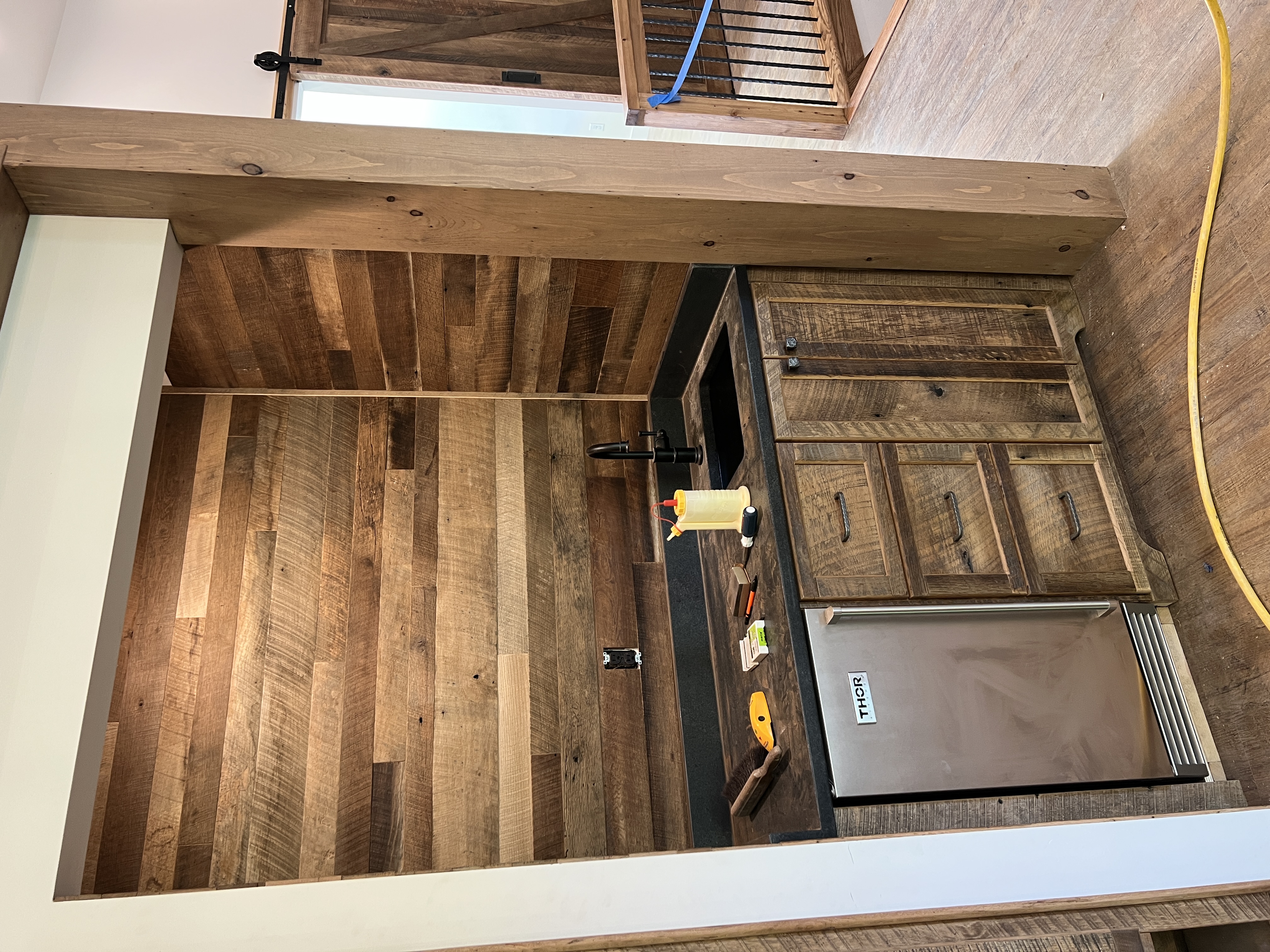
How We Built a Reclaimed Wood Wet Bar in a Waynesville Mountain Home
A Waynesville homeowner wanted a wet bar that felt like it had always been part of the mountain home — not something installed last year. Here's how we sourced 100-year-old hemlock barn boards and turned them into the centerpiece of their great room.
The Brief
When the Hendersons called us, they had a clear vision: a wet bar in the corner of their great room that felt like it had always been there. Not a showpiece. Not something that screamed "renovation." Something that belonged.
The home was a 1980s mountain cabin in Waynesville, NC — exposed timber frame, stone fireplace, wide-plank pine floors. They wanted the bar to match that language. New wood wasn't going to cut it.
Finding the Right Wood
We sourced the primary material from a 150-year-old hemlock barn about 40 minutes outside of Canton. The barn had been standing since the 1870s and was being carefully deconstructed by its owner. The boards had that unmistakable old-growth character: tight grain rings, natural grey patina on the face, and a density you simply cannot find in new-growth lumber.
We pulled about 200 board feet of usable material — enough for the cabinet faces, the shiplap wall surround, and the floating shelves above the bar.
Preparation
Every board went through our full reclaimed wood process:
- Hand-cleaned to remove dirt, old paint, and surface debris
- Kiln-dried to stabilize moisture content and eliminate any organisms
- Milled to consistent thickness while preserving the natural face character
- Graded and sorted by grain pattern and color for visual consistency
The goal is always to preserve what makes old wood special — the character marks, the color variation, the history — while making it structurally sound and dimensionally precise enough to build with.
The Build
The cabinet boxes were built from 3/4-inch cabinet-grade plywood with solid poplar face frames — our standard construction regardless of the door material. The reclaimed hemlock was used for the door faces, the shiplap surround, and the floating shelves.
We paired the warm grey-brown of the hemlock with a matte black countertop and a Thor 24-inch undercounter refrigerator. The hardware was oil-rubbed bronze — simple, period-appropriate, nothing that competed with the wood.
"It looks like it was always there. Our guests think it's original to the house. That's exactly what we wanted." > — Henderson Family, Waynesville, NC
The Finish
We finished the hemlock with Gemini Epic Evo in a satin sheen — the same commercial-grade conversion varnish we use on all our work. It's harder and more durable than standard polyurethane, and it doesn't yellow over time. On reclaimed wood, it enhances the natural color variation without making the wood look "finished" in a way that kills its character.
What We Learned
Reclaimed wood projects require more planning time than new wood projects — sourcing, drying, and milling add lead time. But the result is something genuinely irreplaceable. No two pieces of old-growth hemlock are alike. The bar we built for the Hendersons is the only one like it in the world.
If you're considering a reclaimed wood project in Western North Carolina, East Tennessee, or Upstate South Carolina, we'd love to talk through what's possible. The consultation is free, and we bring samples.
Inspired? Let's Build Something Together.
Free consultation. Personal response from Jonathan or Jeff within 24 hours.
START YOUR PROJECT