
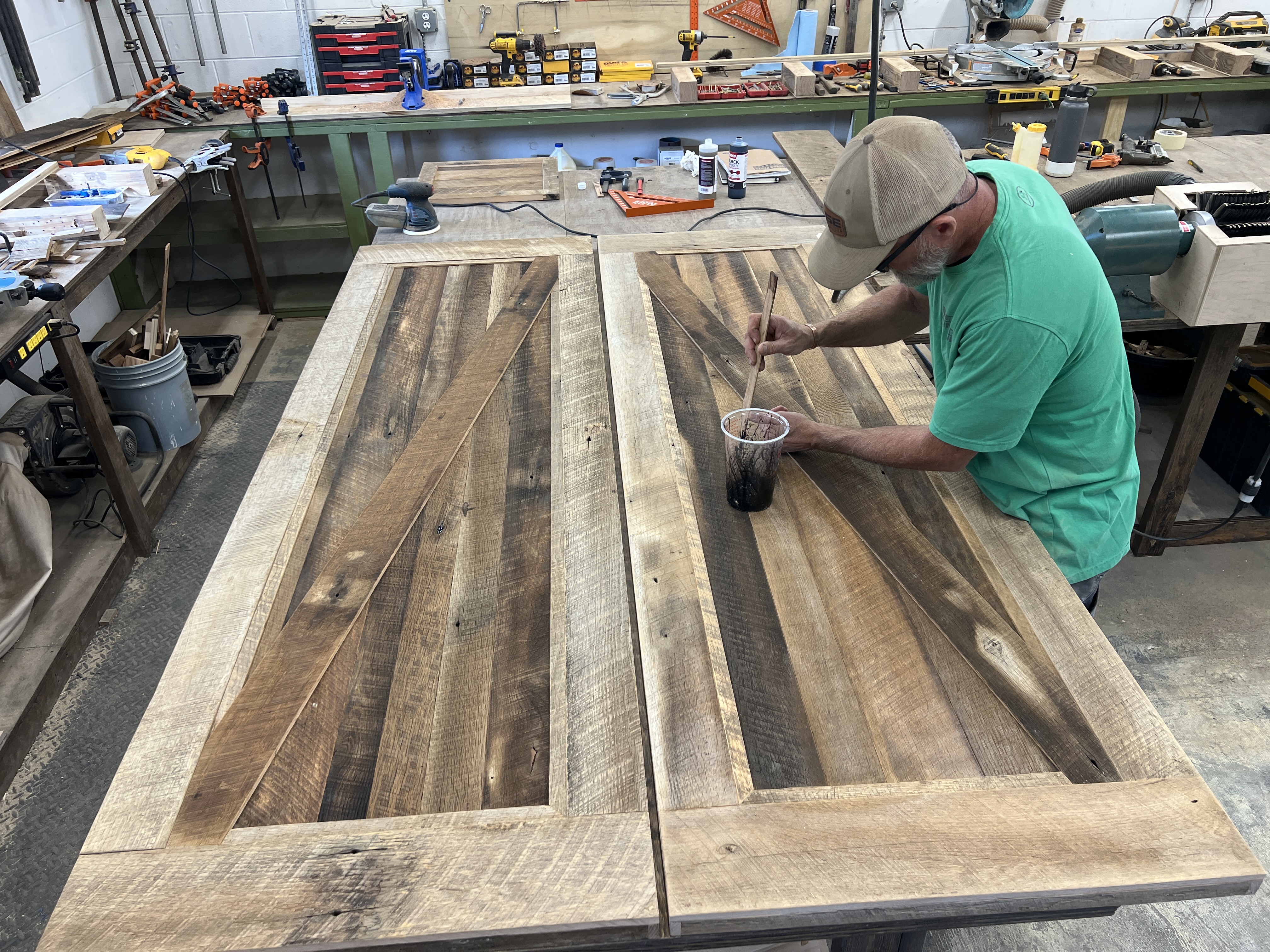
Inside the Canton Workshop: The Tools, the Process, and the Craft Behind Every Legacy Piece
Step inside Legacy Woodcraft's Canton, NC workshop and see exactly how a raw board becomes a heirloom-quality cabinet — from the first cut to the final coat of Gemini Epic Evo.
The Address on Cruso Road
At 6841 Cruso Road in Canton, North Carolina, there is a workshop that doesn't look like much from the outside. It sits in Haywood County, tucked into the mountain landscape that has defined Western North Carolina for generations. But inside, something precise and deliberate is happening every single day.
This is where Jeff and Jonathan Cairnes build Legacy Woodcraft pieces — custom cabinetry, reclaimed wood furniture, wet bars, built-ins, and dining tables that will outlast the homes they go into. This post is a look behind the door at what that actually means: the tools, the sequence, the decisions, and the standard that every piece has to meet before it leaves.
---
The Material Standard — Before a Single Cut Is Made
The first thing that separates a Legacy piece from a competitor's piece isn't the joinery or the finish. It's the sheet goods.
Every Legacy cabinet box is built from **3/4" cabinet-grade plywood**. That's the standard. Not 1/2". Not 3/8". Not the particleboard cores that fill the interiors of most semi-custom and even some "custom" cabinet lines. Three-quarter-inch cabinet-grade plywood throughout — top, bottom, sides, and back.
Most shops use 1/2" plywood for the box sides and 1/4" plywood for the backs. It saves money. It also means the cabinet will rack, sag, and fail under load over time. Legacy cabinets are built to hold cast iron cookware, stone countertops, and decades of daily use without movement.
The face frames are solid wood — the same species as the door fronts, cut and joined in the shop. No MDF face frames. No vinyl wraps. Solid wood, properly dried, properly milled.
---
The Tools That Do the Work
The Legacy workshop is equipped with professional-grade machinery, not hobbyist tools. Here's what's running on any given build day:
**Table Saw** — The heart of any cabinet shop. Used for ripping sheet goods to width, cutting face frame stock, and dimensioning solid lumber. Precision here is non-negotiable — a 1/32" error on a table saw compounds across 20 cabinet boxes.
**Cabinet Saw / Panel Saw** — For breaking down full 4×8 sheets of plywood accurately and safely before they go to the table saw. Full sheets of 3/4" plywood weigh over 60 lbs and require controlled handling.
**Jointer and Planer** — Used to true up solid lumber before it becomes face frames, drawer fronts, or furniture components. The jointer flattens one face and one edge; the planer brings the board to a consistent, parallel thickness. This is how you get a face frame that sits perfectly flush with a cabinet box.
**Router Table** — Used for profile work on door edges, drawer fronts, and decorative molding. Also used for cutting dadoes and rabbets in cabinet construction — the joints that give a box its structural integrity.
**Pocket Hole Joinery System (Kreg)** — The primary joinery method for face frames and cabinet assembly. Pocket hole joints are fast, strong, and reliable when done correctly. Every joint is glued and screwed.
**Miter Saw** — For crosscutting face frame stock, trim pieces, and furniture components to precise length. A quality stop system allows repeatable cuts across dozens of identical pieces.
**Random Orbital Sander and Belt Sander** — Finishing work before stain or paint. Every surface that will be seen or touched is sanded through progressive grits — typically 80, 120, and 180 — before any finish is applied.
**Spray System** — This is where Legacy separates from most shops. The finish is applied with a professional spray system, not a brush or roller. Brushed finishes leave marks. Rolled finishes leave texture. A properly sprayed finish is smooth, even, and durable in a way that hand-applied finishes cannot replicate.
---
The Finish That Changes Everything
Most custom cabinet shops use standard polyurethane or a water-based lacquer. These are fine finishes. They are not what Legacy uses.
Every Legacy piece is finished with **Gemini Epic Evo** — a commercial-grade catalyzed finish used in professional kitchen and commercial environments. It is the same class of finish found in restaurant kitchens and high-end commercial millwork. It is harder, more scratch-resistant, more moisture-resistant, and more UV-stable than standard polyurethane.
The application process matters as much as the product. Surfaces are sanded between coats. The spray environment is kept clean. Dry times are respected. The result is a finish that looks like glass and holds up like armor.
When a homeowner tells us their cabinets still look new after ten years of daily cooking, that's not luck. That's the Epic Evo.
---
Reclaimed Wood: A Different Kind of Process
When a project involves reclaimed wood, the process changes significantly — and the skill required goes up.
Reclaimed wood arrives at the shop in rough form: old barn boards, hand-hewn timbers, salvaged flooring. The wood has already lived one life. It has nail holes, saw marks, weathering, and character that new lumber simply cannot replicate. The challenge is working with that character rather than against it.
The reclaimed material is first **inspected and sorted** — checking for hidden nails and hardware with a metal detector, identifying checks and splits that need to be stabilized, and selecting boards for their grain pattern and color consistency.
Then it goes through the **jointer and planer** — carefully, because old wood can be unpredictable. The goal is to clean up the faces and edges enough to work with while preserving the patina and texture that makes reclaimed wood worth using in the first place.
From there, the process is similar to new wood construction, but with more hand work. Fitting reclaimed boards into a cabinet or furniture piece requires reading each board individually. No two are the same. That's the point.
The finish on reclaimed work is typically a penetrating oil or a low-sheen topcoat that enhances the natural color and grain without obscuring the wood's history. The goal is always the same: old wood that looks intentional and refined, not rough and neglected.
---
The Standard Before It Leaves
Before any piece leaves the Canton workshop, it goes through a final inspection. Doors are hung and adjusted. Drawers are fitted and tested. Every joint is examined. Every surface is checked under raking light — the most unforgiving way to find a flaw.
If something isn't right, it doesn't ship. That's not a policy statement. It's just how Jeff and Jonathan operate. When you've been building since 1987, you develop an internal standard that is harder to satisfy than any client specification.
The 2-year workmanship warranty on every Legacy piece isn't a marketing promise. It's a reflection of the fact that in the history of the business, very little has ever needed warranty work. The pieces are built correctly the first time.
---
Why This Matters to You
If you are considering a custom cabinetry or furniture project, understanding what happens in the workshop is relevant to your decision. The difference between a $400/ft cabinet and a $1,000/ft cabinet is not primarily visible in the finished door. It is in the sheet goods behind the door, the joinery holding the box together, the finish protecting the surface, and the hands that built it.
Legacy Woodcraft builds at the top of that range — not because of marketing, but because of what goes into every piece before it ever reaches your home.
If you'd like to see the workshop in person, we welcome visits by appointment. Reach out to Jonathan at 828-550-4834 or [email protected] to schedule a time.
Inspired? Let's Build Something Together.
Free consultation. Personal response from Jonathan or Jeff within 24 hours.
START YOUR PROJECT